
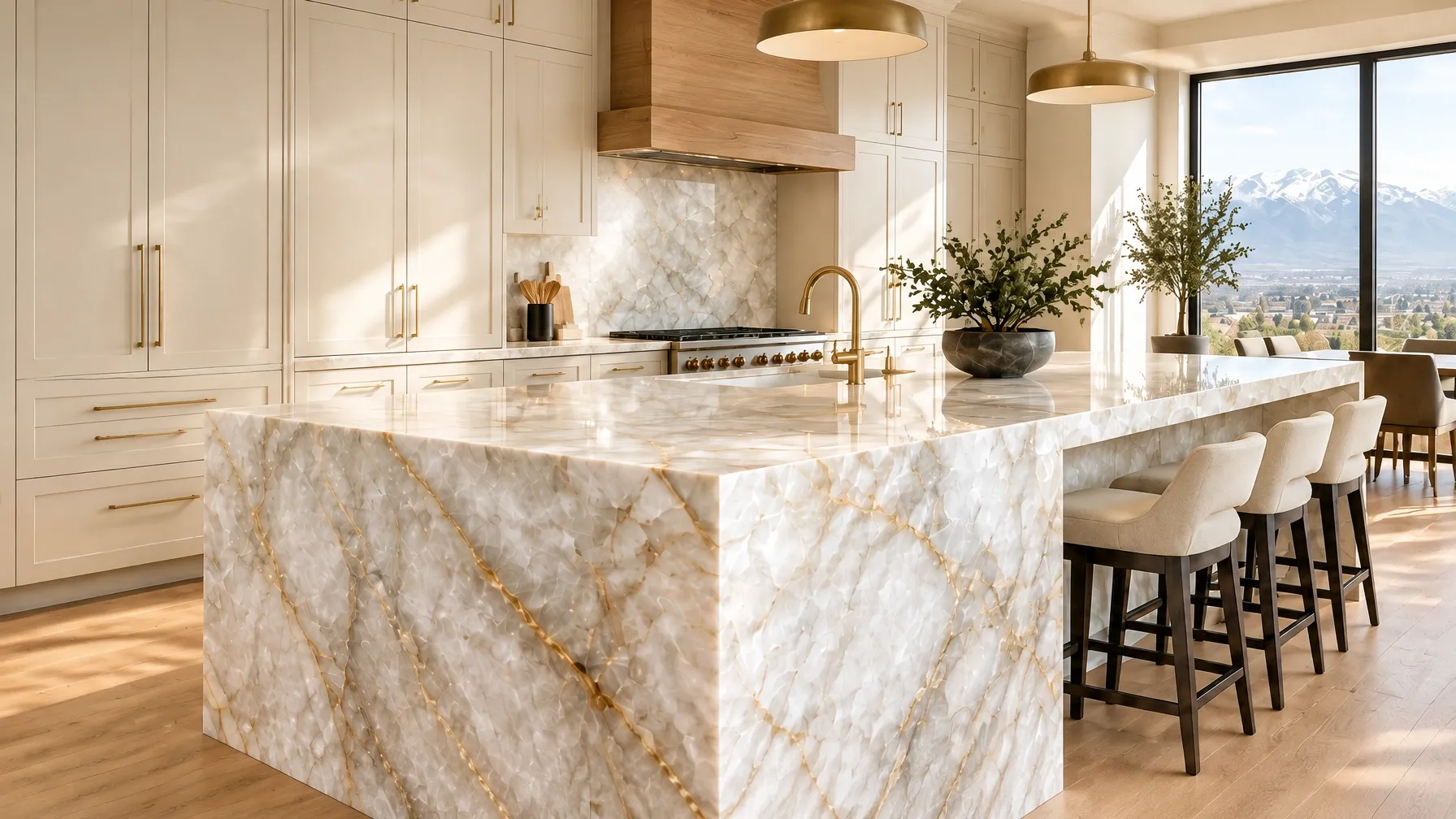
Quartzite is a natural stone with the flowing patterns many people love in marble and the toughness they want for a busy kitchen. But it is not maintenance-free, and two slabs with the same name can look very different. Here’s what to understand about quartzite countertops before you choose a slab, plan a budget or start a remodel.
What Quartzite Is, and What It Isn’t
Natural quartzite begins as quartz-rich sandstone. Heat and pressure transform it into a dense metamorphic rock. It is not the same as engineered quartz, which is made from crushed minerals, pigments and resin.
That difference matters. Quartzite is generally very heat-resistant and does not usually etch from household acids the way marble can. Engineered quartz is consistent and easy to care for, but its resin can be damaged by high heat. Hardness ratings can overlap, so “harder” is not a simple one-number comparison; the practical distinction is that natural quartzite handles heat better than resin-based quartz surfaces.
Confirm the exact material with a knowledgeable supplier. Some stones sold under quartzite names may be softer or more reactive than true quartzite. Ask about the slab’s properties and care instructions before committing.

Quartzite Durability: The Honest Pros and Cons
What it does well: True quartzite is highly scratch-resistant for everyday kitchen use and handles heat well. It comes in natural patterns that can’t be replicated exactly, from quiet, pale movement to bold veining. Some varieties, including Cristallo, are translucent enough for backlighting.
What to keep in mind: Quartzite is still natural stone. Porosity varies by slab, so sealing is often needed to reduce the risk of staining. The stone can also be brittle at narrow edges or around sink and cooktop cutouts, where chips are more likely if it is struck. Natural fissures and variation are part of the material; they can affect both appearance and fabrication.
Inspect the actual quartzite slab you plan to use, not only a small sample. A photo or showroom sample can’t show every feature of a full slab.
How Much Do Quartzite Countertops Cost?
As a broad 2026 planning range, quartzite countertops often run about $70–$200+ per square foot installed. Entry-level or more readily available stones tend to sit toward the lower end; rare or highly figured materials, including Cristallo, can fall around $150–$250+ per square foot installed. These are broad market ranges, not a project quote. Regional labor rates, slab availability and scope move the number considerably.
| Cost factor | Why it affects the total |
|---|---|
| Stone variety and slab availability | Rare, imported or highly sought-after material can cost more. |
| Square footage and slab yield | Layout, vein direction and waste determine how much stone is needed. |
| Thickness and edge profile | Thicker edges and more detailed profiles require additional material and labor. |
| Waterfall ends and cutouts | Island sides, sinks, cooktops and fixtures add fabrication steps. |
| Seams and slab matching | Layout and vein alignment can influence slab use and labor. |
| Tear-out, stairs and site access | Removal, difficult transport and complex installation conditions add work. |
The final number depends on material, square footage, edge profiles and installation complexity. For a project-specific estimate, have the fabricator review the layout and slab together.
Quartzite vs. Quartz vs. Granite
| Feature | Quartzite | Engineered quartz | Granite |
|---|---|---|---|
| Material | Natural metamorphic stone | Manufactured surface with mineral and resin content | Natural igneous stone |
| Appearance | Distinctive natural variation | More consistent patterns and colors | Natural variation, often granular or boldly veined |
| Heat | Generally very heat-resistant; use trivets near vulnerable areas | Use trivets; resin can be heat-sensitive | Generally very heat-resistant |
| Staining and sealing | Porosity varies; sealing is often recommended | Nonporous; generally no sealing | Sealing is commonly recommended |
| Best fit | Natural movement, heat tolerance and statement surfaces | Consistency and lower routine maintenance | Natural stone with a broad range of styles |
The right choice depends on how you use the room and how much upkeep you’re comfortable with. If heat tolerance and a one-of-a-kind pattern matter most, quartzite earns its place. If you want no sealing and identical repetition, engineered quartz is the easier surface.
Choosing a Slab in Person
View the full slab in the kind of light your project will have, and bring cabinet, flooring and paint samples if possible. Look at the overall pattern, then check edges and natural fissures. For a large island or a waterfall, ask the fabricator how the layout will use the slab and where seams may fall.
Cristallo quartzite is a good example of why an in-person viewing helps: its color, veining and translucency vary by slab, and no photograph captures that honestly. Peak Stoneworkz is Utah’s official distributor for Alliance Cristallo, with varieties including Cristallo Oro, Puro, Azurro, Supremo Oro, Ombra and Rosa. You can see the Cristallo collection, read more about quartzite as a material, and arrange to view available slabs at the Salt Lake City warehouse.
Fabrication and Seams: The Hidden Variable
Hard stone takes skill and suitable equipment to cut cleanly. Precise templating, a thoughtful layout and careful handling around cutouts and edges all matter. So does seam placement: a seam may be visible depending on the stone’s pattern, lighting and location, even when it is carefully fabricated.
Ask who will template, fabricate and install the countertop, and how they plan to position seams and match the stone. Peak Stoneworkz handles projects from sourcing through installation, using in-house diamond-wire precision fabrication and a seam-bonding silicone engineered to hold without separating over time. Seam placement still matters: we plan the layout around the slab’s veining so the joint lands where it disappears.
Care and Sealing
Clean quartzite with mild dish soap or a pH-neutral stone cleaner and a soft cloth. Avoid acidic cleaners such as vinegar or lemon-based products, as well as abrasive pads. Wipe spills promptly, especially oils, wine and strongly colored liquids.
Many quartzite slabs should be sealed at installation, but sealing frequency depends on the specific stone and product used. Rather than relying on a fixed calendar, ask your fabricator for slab-specific guidance. A simple water test can help: if water darkens the stone quickly, it may be time to reseal.

Where Quartzite Works Best
A quartzite kitchen island makes a strong focal point, especially when the pattern continues over waterfall edges. Quartzite also suits bathroom vanities, fireplace surrounds and feature walls. Translucent Cristallo can be backlit for a distinctive panel or wall.
Outdoor kitchens can work too, but the right stone, sealer, installation details and exposure matter, particularly in the Mountain West, where temperatures swing. Discuss the exact application with your fabricator before selecting a slab.

Quartzite Countertops FAQ
Are quartzite countertops durable?
Yes. True quartzite is a hard, heat-resistant natural stone, but it can chip at exposed edges and may need sealing to help prevent stains.
Can I put a hot pan on quartzite?
Quartzite handles heat well, but trivets are still a sensible precaution, especially near seams, cutouts or resin-filled fissures.
Does quartzite stain?
It can. Porosity varies by slab, and oils or colored liquids may leave marks if the stone is unsealed or a spill sits too long.
How often does quartzite need sealing?
There isn’t one schedule for every slab. Follow your fabricator’s care instructions and reseal when the stone’s behavior indicates it needs it.
Will I see seams?
Seam visibility depends on the pattern, placement, lighting and workmanship. Review the planned layout with your fabricator before cutting.
Does quartzite require a lot of maintenance?
No special routine is needed beyond regular cleaning and checking whether the slab needs resealing.
Are quartzite countertops worth it in Utah?
They can be a good fit for homeowners who value natural variation and heat resistance. For outdoor use, confirm the particular slab and installation are suited to the exposure and local conditions.
How long does installation take?
The schedule depends on slab availability, templating, fabrication, project readiness and the installer’s schedule. Many projects take a few weeks after final measurements, but timing varies.
If you’re comparing quartzite countertops in Utah, come see the stone in person. Slabs are on view at our Salt Lake City warehouse by appointment, Monday through Saturday — 475 W 3600 S. Call 385-529-8401 or email info@peakstoneworkz.com to arrange a visit or request a quote.